
What is false optimism?
I’ve received some interesting feedback. It’s more of a warning about false optimism. This led me to ask, “What is false optimism?” At the same time, I also felt an impending sense of doom. After long periods of struggle, where nothing seemed to go according to plan, regardless of planning tools or prep, something left me feeling as though I was not meant to succeed. This was agonizing, and now I’m being warned about false optimism-what does that mean for me?

Perhaps I was triggered. I am rather optimistic. For the past while, that optimism hasn’t served me well. Those who know me would be surprised to find me more grounded than usual. After leaving an enjoyable career to pursue my dreams as a writer, a coach, and a realtor to sacrifice more than I had to give for 2 solid years, I was depleted and empty-handed. Moving away from my baseline optimism felt uncomfortable. And yet, I’m being warned, not to return to my optimistic self? Why might this be??
For starters, it’s time to get over feeling triggered. This is advice, not condemnation. My inner 3-year-old was having a temper tantrum that I needed to recognize. Screaming “Wait! You mean after all this time of nothing working out, again we have to endure a period of nothing working out?!” Ok little self, I see you, I hear you, and your thoughts and feelings are valid. >>hugs self<<
What if there was a deeper less disturbing meaning? Now, my mind is open and curious… what else could this mean?
What if false optimism is the idea that something will work out, but it hasn’t been properly tested or vetted? What if the advice is intended to be more keen and sharp rather than too dreamy and biased or living primarily on ideals? A call to action that states: Be willing to do the work and stop at nothing! Don’t be setback by failure, allow it to shape you forward.
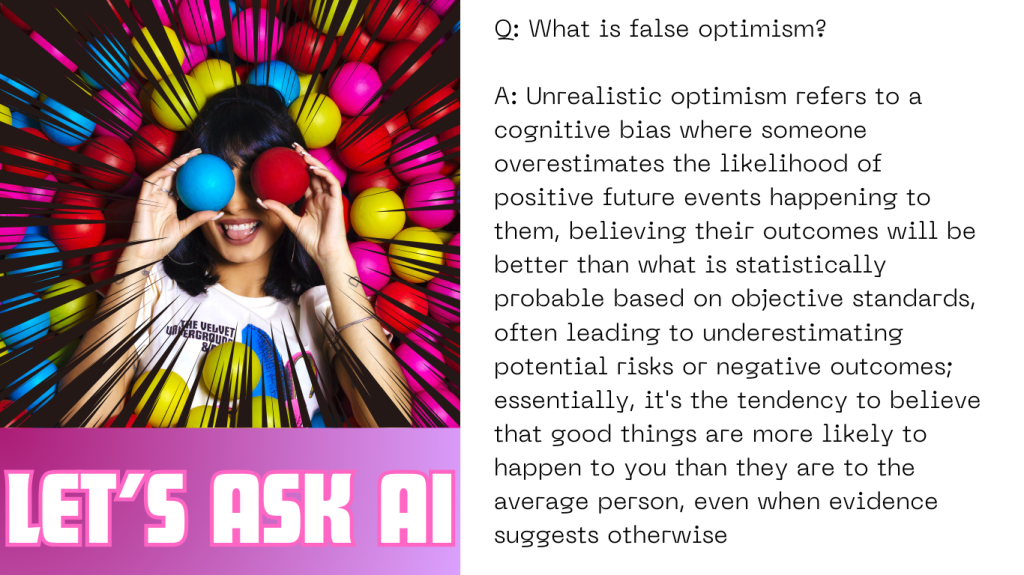
I like that AI replaced “false” with “unrealistic”. I’m giggling because a lie is a lie bro. Cognitive bias reinforces the belief that success doesn’t come easy for me. This is because the lessons (rather than blessings) that life presents us with, bring confirmation of challenges rather than the ease of success, which can, in turn, yield a confirmation bias.
To unpack this confirmation bias, one may discover this cognitive bias that wreaks of entitlement. This bias isn’t grounded in reality. It’s the belief that ‘Good things are more likely to happen to me than to the average person,’ even when evidence suggests otherwise. It’s then followed by disappointment, empty-handedness, and a bad attitude fixated on the pattern of failures.
Overcoming Cognitive Bias & Emotional Setbacks
Believing success doesn’t come easy is a powerful yet limiting affirmation. Life comes with challenges by proxy. It’s a relentless giver of opportunities (lessons) to learn and grow from. When we view lessons as punishment and internalize that… Honey… We will be emotionally setback, perhaps even more so than the lesson had intended. This is because the personal will is powerful.
We have covered how powerful we are, which leads us to how powerful a growth mindset is. We can also see how vulnerable we are, and how easily we can get sucked into the abyss of suckages which may exacerbate the damage.
I appreciate AI’s take on false optimism because it humbly illustrates how biases and entitlement can create a sense of failure. It’s worth noting that some of the struggles I shared earlier weren’t exclusively about mindset. They resulted from real effort, planning, and performance—perceivably more than what the average person or new realtor would do. Leaving with less than the average person and realtor fed the “success doesn’t come easy for me” narrative.
I believe this is why my inner 3-year-old had a tantrum.
The point isn’t to stay stuck in a feeling. It’s to move forward with a better sense of intel. Don’t do the same thing over and over and expect a different result. Adjustments are needed, and sometimes it’s mindset. You’re not prone to more misfortune than the next person. You may have blinders on that make you human, not less than or unlucky.
Recognizing false optimism is just the first step. The real shift happens when we embrace iteration—using failures as stepping stones to refine our approach. Learning from doing is one of the best ways to fail, and makes you a successful failure! This is not meant lightly or sarcastically. Getting good at failing comes with secret lessons afforded by courage. Courage to try, courage to fail, and courage to try again! Welcome to iterative change.
The Power of Iteration & Growth Mindset
When you hear the word “iteration” what comes to mind? Change? An Idea that evolves through continuous improvement?
The funny thing is false optimism, and iteration overlap. False optimism served as a warning: things are not always what they seem. And when they aren’t, it’s time for iteration.

Iterative change is the process of refining and improving something through repeated cycles of testing, feedback, and development. This is a constructive way to look at results that do not land on their feet upon the first jump. This is where a growth mindset meets failure. False optimism drains the emotional energy needed to take action.
Taking Action: Moving Forward with Realism
How will you move forward? Perhaps you don’t have a pressing theme of false optimism to navigate, does that mean this information is not helpful or do you see it as a call to action?
It’s time to stop living on a prayer and start living on your feet! Note: It’s ok to keep praying. Prayer with action is more powerful than prayer alone.
As we weave these two concepts “false optimism” and “iterations”, when (and how) does change show up on stage?
My short-lived real estate journey taught me critical lessons about starting a business, helped me understand the need for and how to create a powerful network, and that dreams don’t work unless you do.
Reactive minds will wait for it, and react accordingly. Contrastingly, those who value what it means to “own their shitake“, will take this as a proactive call to action.
Those who own their actions and results will have thoughts like “I need to drive change” and “I need to be a change agent“. They will be aware that the first draft is exactly that, not the final product. They don’t get too excited about 1.0 if it doesn’t meet the epic definition of done or the final goal.
It’s important to see the need to break down big goals into smaller chunks, so that those little steps are the 1.0, 2.0, etc. From there, you will have a realistic checklist, and avoid false optimism. This is a grounded reality when one takes initiative and sees these steps as intel or a feedback loop rather than an emotional setback or punishment.
Let’s work on a new affirmation: By working through my failures I achieve success!
The warning about false optimism wasn’t a roadblock—it was a guidepost. And now, instead of resisting the lesson, I’m embracing it as part of my evolution.
 Write A New Beginning
Leave a comment